

Good coffee table styling ideas make a living room feel finished without making the table useless. The best setups look collected, not staged, and they still leave room for a mug, a book, and your feet. Below is a simple three-group formula, matched to your table shape, plus the mistakes to avoid.
What Coffee Table Styling Really Means
A coffee table is the one surface every seat can reach, so it does two jobs at once. It holds the things you use every day, and it sets the tone for the whole room. When the table looks calm, the room feels calm too.
Styling is not about buying a set of matching objects. It is about choosing a few pieces that work together, each with a clear spot. A styled table tells a story. The books on top show what they read. A plant shows they like green things near. A bowl from a trip shows where they went. So the goal is simple. The table should look good in a photo and still work at 9 pm when someone puts their feet up. If you have to move five objects before you can set down a cup, the styling has failed.
Start With the Table, Not the Decor
Most styling guides start with accessories, but that is the wrong order. Start with the table itself, because its size, shape, and height decide what can sit on it.
Match the Table to the Sofa
Generally, the table should be about two-thirds as long as your sofa. A sofa that is 210 cm long pairs well with a table around 120 to 140 cm long. If the table is too short, it looks lost. If it is too long, it crowds the room.
Leave about 40 to 45 cm between the sofa edge and the table edge. That gap is enough to walk past and close enough to reach a drink. In a small room, you can shrink it to 35 cm, but do not go below that. Also check the height: a good coffee table sits at about the same height as your sofa seat, or up to 5 cm lower.
Leave Room to Use It
Plan to leave at least half the tabletop clear. It sounds like a lot, but it is the rule that keeps a styled table livable. The clear half is where mugs, plates, and laptops go.
On a rectangular table, style one end and leave the other end open. On a round table, style one side and leave the other side open. The open space is not empty: it is the space that makes the styled part look good.
The Three-Group Formula That Always Works
Here is the formula. Divide the table into three groups, and give each group one job: one adds height, one adds a flat base, and one adds life. Three groups are enough for most tables, and five are the most for a very large one. Odd numbers work better than even ones, because three objects feel natural to the eye while four feel like a row.
Group One: A Book Stack
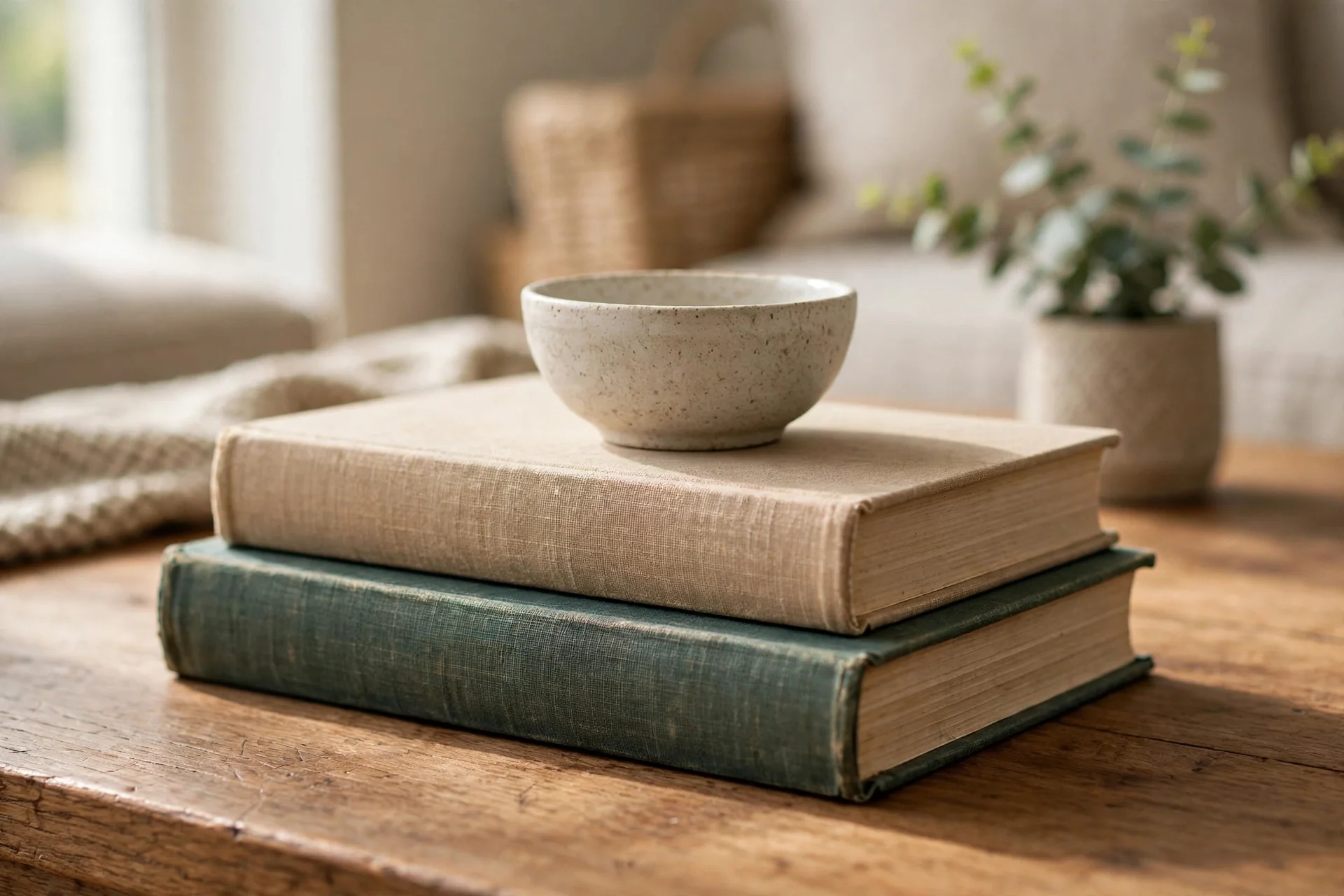
Books give a table height, colour, and a flat base for smaller objects. Stack two or three large hardcovers, with the largest at the bottom. Turn the spines toward the main seat so the titles read easily. Pick books you actually like. Art, travel, food, and gardening titles all work well.
Also, keep the stack under about 15 cm tall. A taller stack blocks the view and starts to wobble. Top it with one small object only, such as a ceramic bowl, a stone, or a pair of reading glasses. A stack about things you love looks honest, while a stack bought only for the covers looks like a shop display.
Group Two: A Tray or a Bowl
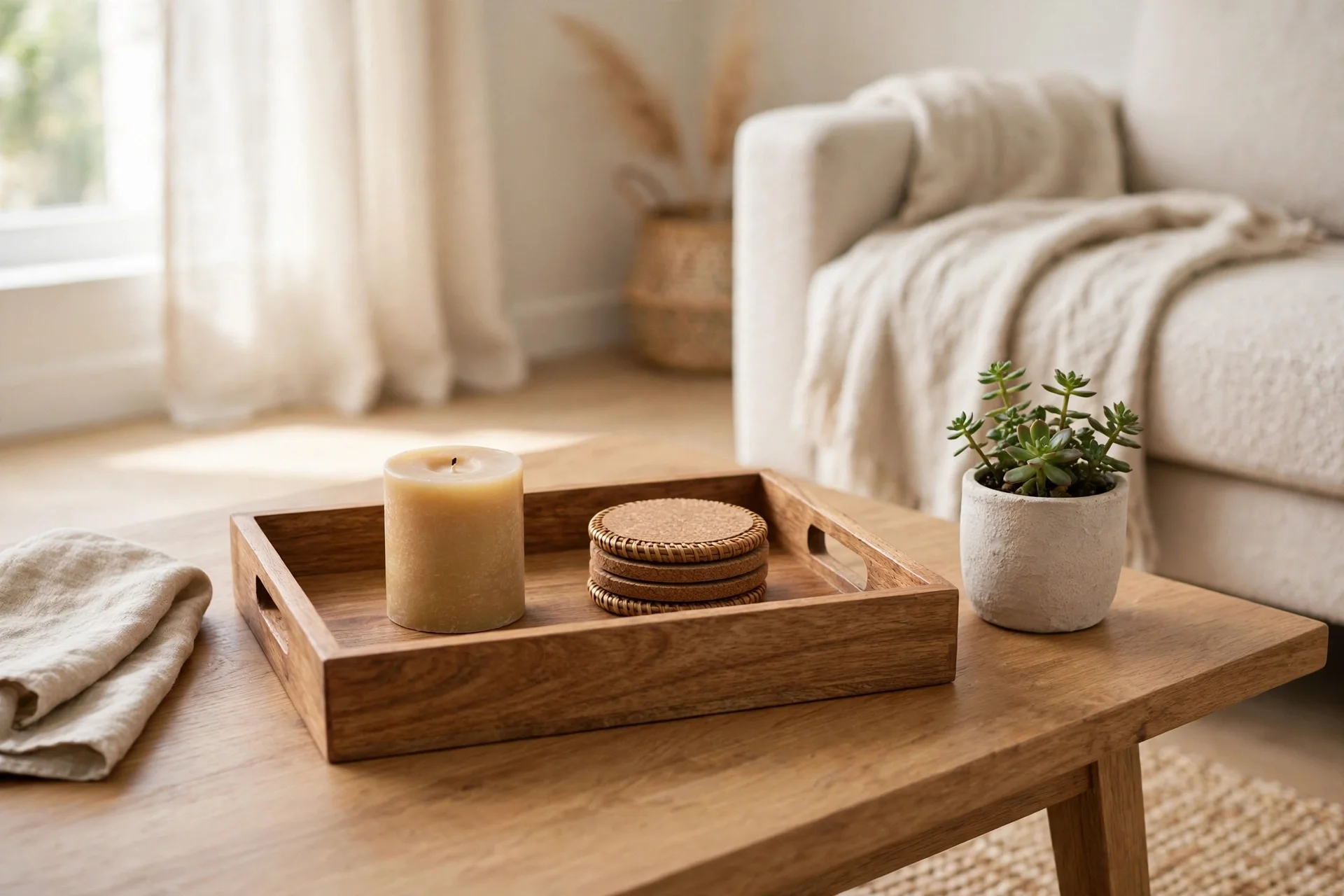
Also, a tray turns loose items into one group you can lift off in seconds. Pick one in wood, rattan, metal, or leather, and make sure it covers no more than half the tabletop. Inside it, place a candle, a small plant, and a set of coasters.
A bowl does the same job in a smaller space. A wide, shallow bowl holds keys, a remote, or a few pinecones, and it keeps small things from drifting. Trays also protect the table, because a hot mug or a wet glass sits inside the tray, not on the wood.
Group Three: Something Alive
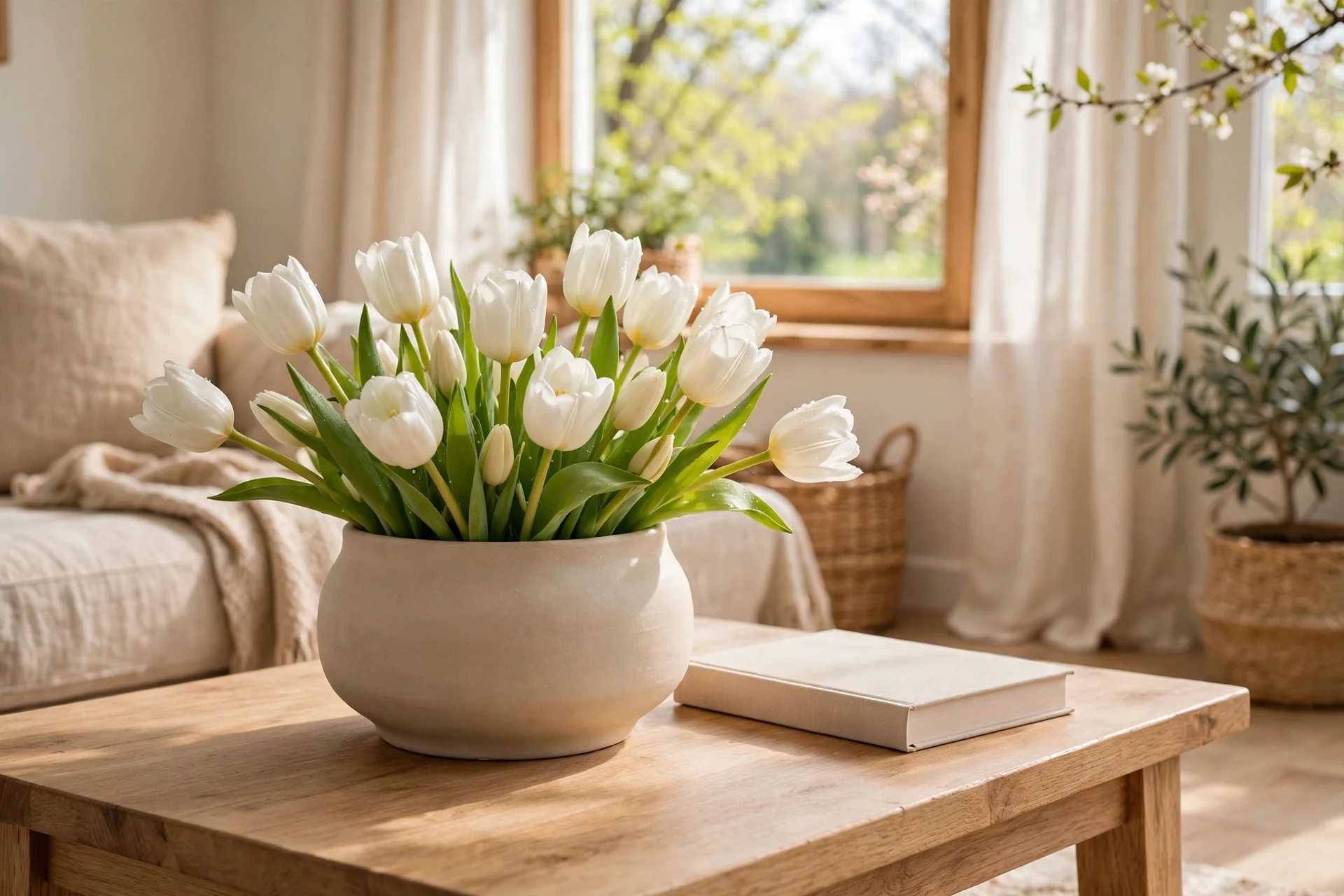
Finally, every styled table needs one living thing. A small plant, a vase of fresh flowers, or a bowl of green branches all work. The living thing adds colour and softness that no object can match.
Keep it low, under 30 cm tall, so it will not block anyone’s view. A tall vase looks grand in a photo, but it gets in the way when two people talk. If real plants die in your home, use good fake greenery. A few eucalyptus stems in a glass bottle look fine all year.
Coffee Table Styling Ideas for Different Table Shapes
Still, one formula does not fit every table. The shape changes where the groups go, so here is how to place the three groups on the three most common shapes.
Rectangular Tables
A rectangular table has a clear long axis, so use it. Put the book stack at one end, the tray in the middle, and the plant at the other end. That gives three points along the length. Keep the tallest group at one end. Height at the end reads as a frame, while height in the middle reads as a wall.
If the table is very long, over 130 cm, add a fourth small group near the centre. A low bowl or a single candle works well. But do not add a fifth group. Four is the limit here, and the rest of the top stays clear for drinks.
Round and Oval Tables
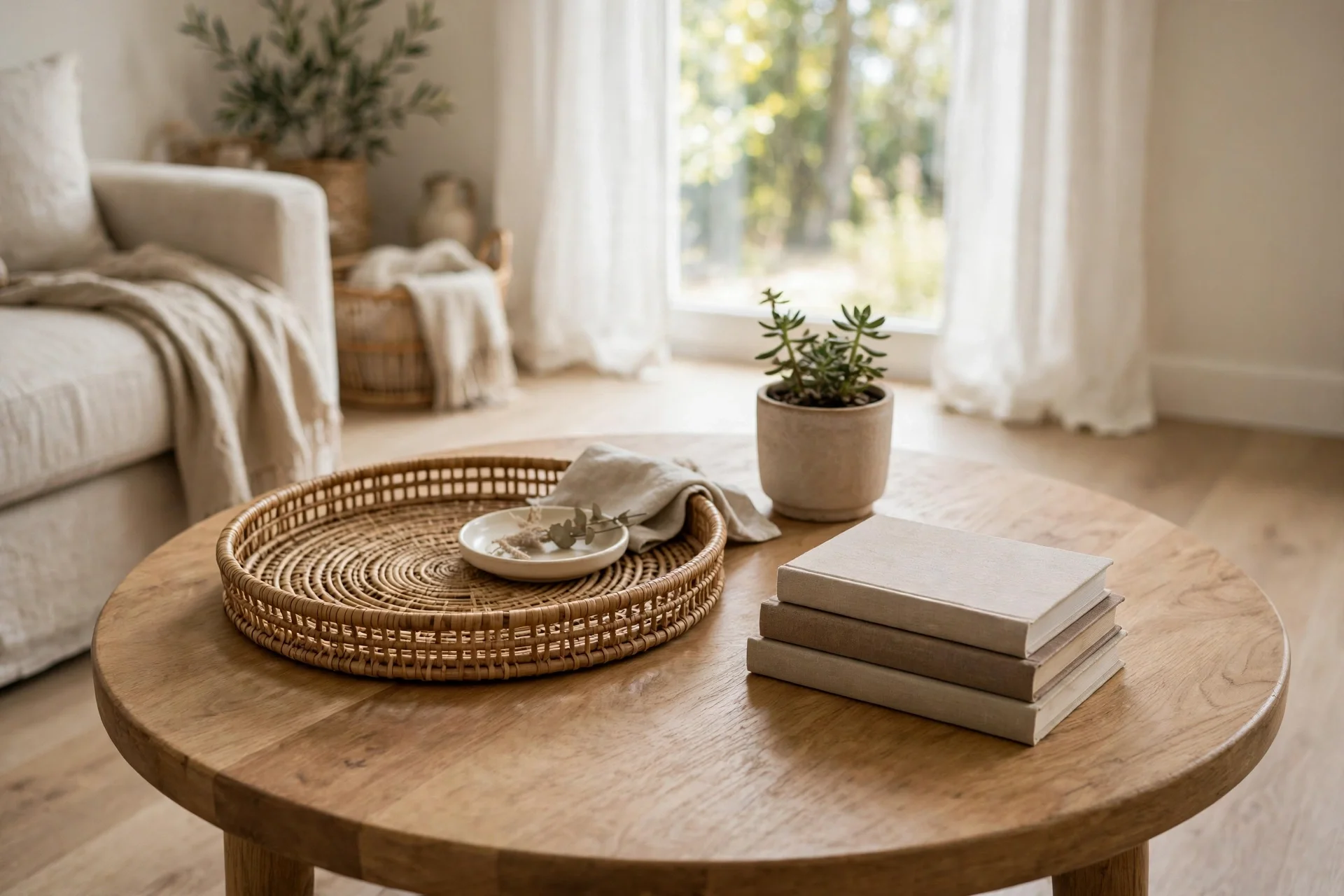
A round table has no ends, so the groups sit in a loose triangle. Place the book stack on one side, the tray opposite it, and the plant between them, then leave the fourth side open for drinks. A round tray echoes the table shape and pulls the groups together, while a square tray on a round table can look awkward.
Oval tables work like rectangular ones, but softer. Place the groups along the long axis, just as you would on a rectangle. The curved ends forgive a group that sits slightly off centre.
Square Tables
A square table is the hardest shape to style, because it has no long axis and groups can look scattered. The fix is to anchor one corner. Put the tallest group in one corner and a low group in the opposite corner. Leave the other two corners clear.
Use a tray on a square table, because the tray gives the groups a clear border and stops them from drifting apart. Without a tray, small objects tend to slide toward the middle and bunch up. If your square table is small, under 80 cm across, use only two groups: a book stack and a small plant.
Mix Heights, Textures and Colour
First, good styling mixes height, texture, and colour. If all your objects share one height, the table looks flat. All smooth surfaces make it look cold. If all are one colour, it looks dull. Mix heights in steps: a low book stack, a medium vase, and a taller candle. Keep the tallest under 30 cm.
Mix textures too. Pair smooth glass with rough wood, or shiny metal with soft linen. A ceramic vase next to a linen-bound book and a brass candle holder gives the table warmth. Three textures are enough.
Colour works best when it repeats something already in the room. Pick one accent colour from your cushions, rug, or art, and echo it on the table. A terracotta candle that matches a terracotta cushion ties the table to the sofa. If the room is mostly neutral, one strong colour adds life, and a deep green plant does it for free. The rug under the table matters too. Check your rug size before you style the table, because the rug sets the frame the table sits in.
A Worked Example: Styling a 120 cm Rectangular Table
Here is a full plan for a common table. The table is rectangular wood, 120 cm by 60 cm, in front of a three-seat sofa. It takes about twenty minutes. First, clear the table completely and wipe it down.
At the left end, stack two hardcover books, the largest at the bottom, with the spines facing the sofa. The stack is about 12 cm tall. On top, place one small ceramic bowl. In the middle, set a rectangular wooden tray, about 40 cm long, with a short pillar candle and four coasters inside. Leave a gap of about 10 cm between the tray and the books.
At the right end, place a low vase with three eucalyptus stems. The vase is 20 cm tall, and the stems rise another 15 cm. That is the tallest point on the table, and it sits at the end, so it does not block the view.
Check the Clear Space
Now step back and check the clear space. The right half of the table, in front of the tray, stays open for mugs. The total styled area covers about half the top, and two people can still set down drinks without moving anything. This plan works because each group has a job. The books add height and a base. A tray gathers the small things. The plant adds life. Swap the bowl for a small clock, or the eucalyptus for fresh tulips, and the plan still works.
How Many Groups Fit Your Table
Use this table to see how many groups your table can hold, and how much space to leave clear.
| Table size | Groups that fit | What to leave clear |
|---|---|---|
| Under 80 cm across | 2 groups | At least half the top |
| 80 to 110 cm | 3 groups | One full side |
| 120 to 140 cm | 3 to 4 groups | One end or one side |
| Over 140 cm | 4 to 5 groups | The centre strip |
Match the Style to the Room
A styled table should match the room it sits in. For example, a modern room suits clean lines, glass, and metal. A rustic room suits wood, linen, and handmade ceramics. If your room leans boho, let the table show it. A rattan tray, travel books, and a trailing plant fit a boho living room far better. A chrome tray and a single white vase would look out of place.
Do not copy a photo exactly. Photos are styled for a camera, not for a living room. Take one idea, such as a tray with a candle, and adapt it to your table.
In winter, a candle and evergreen sprigs make the room feel warm. A warm and cozy living room starts with touches like these.
Mistakes That Make a Table Look Cluttered
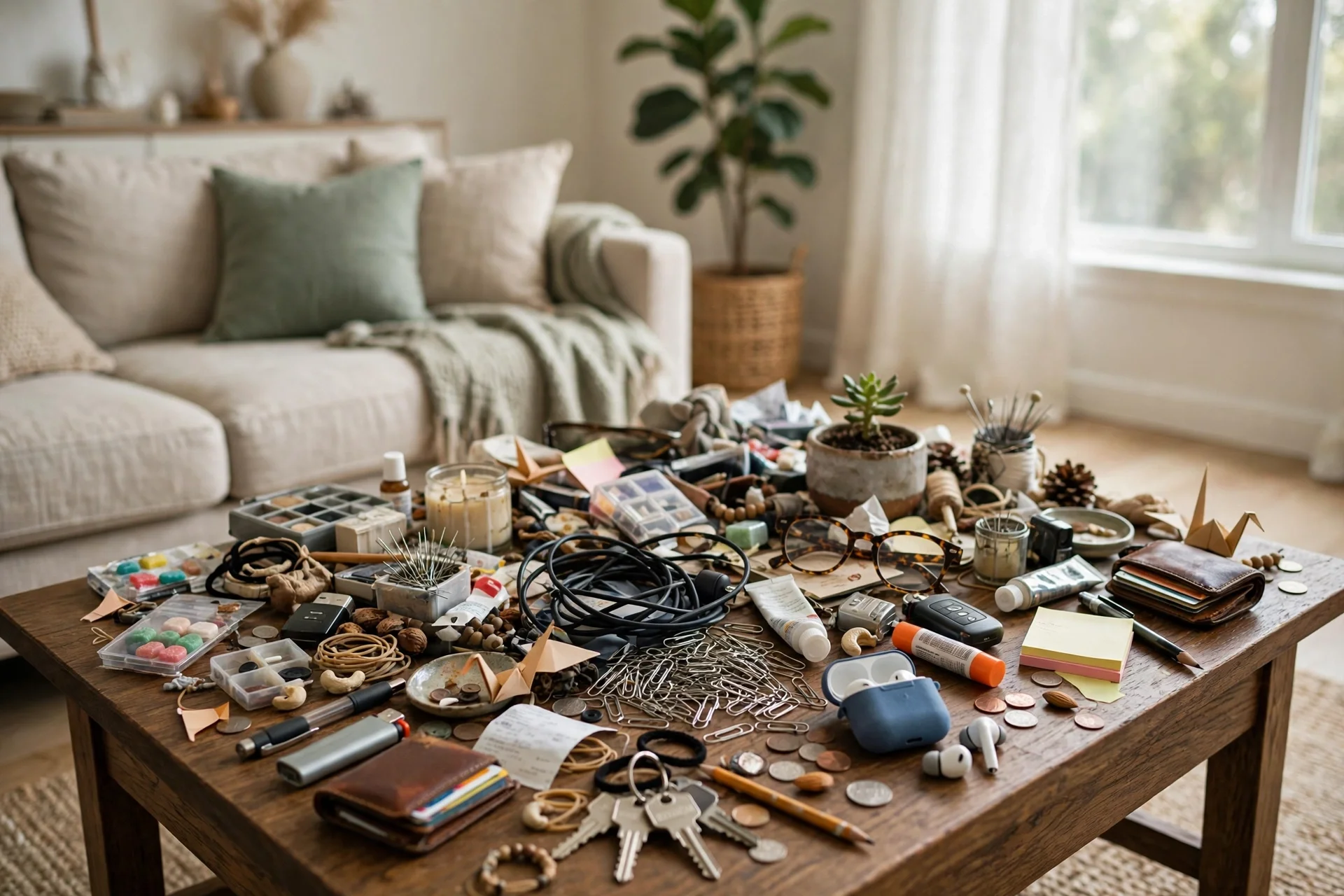
First, the most common mistake is too many small objects. Ten tiny things look like clutter, while three medium things look like styling. So put a collection of small objects inside a tray or a bowl, and the container turns many small things into one group.
Another mistake is copying a trend too literally. For years, many styled tables had the same look: a stack of books with a string of beads draped over it. Designers now say that look is overdone. The Spruce reports that designers say draping beads over a book stack is overdone. A bowl, a small plant, or a found object on top of the books reads fresher today. The books can stay. Only the topping needs a new idea.
Also, a third mistake is matching everything. A tray, a vase, and a candle holder all in the same finish look like a set from a shop. Mix the finishes: wood with brass, or ceramic with rattan, looks collected.
Finally, a fourth mistake is styling for the camera only. If the table looks great in a photo but you cannot put a mug down, it will not last a week. Live with it for two days, and if you keep moving things aside, take one group away. Clean it first too. Dust shows on dark wood and glass. A quick wipe before you place anything makes the whole setup look sharper.
Frequently Asked Questions
How many items should be on a coffee table?
Three groups are enough for most tables, with five as the most for a very large one. Each group can hold two or three small things, but the table should read as three groups, not ten loose objects. Leave at least half the top clear for drinks, books, and laptops.
What is the best height for coffee table decor?
Keep the tallest object under 30 cm so it does not block the view across the room. A book stack of about 12 to 15 cm works well. Add a vase of about 20 cm and a candle of about 10 cm. Together they give a good mix of heights.
How do I style a round coffee table?
Place three groups in a loose triangle: a book stack on one side, a tray opposite it, and a plant between them. Leave the fourth side open for drinks. A round tray echoes the table shape, while a square tray can look awkward on a round top.
Should a coffee table match the sofa?
The table should sit at about the same height as the sofa seat, or up to 5 cm lower. It should be about two-thirds as long as the sofa. The style should echo the room, not copy the sofa exactly. A modern room suits glass and metal, while a rustic room suits wood and handmade ceramics.
How do I keep a styled coffee table tidy with kids?
Use one tray to hold everything, so the whole setup lifts off in seconds when the table needs to be cleared. Choose sturdy pieces, skip glass vases at child height, and keep the styling low. A wooden tray, board books, and a fake plant survive small hands far better than candles and ceramics.
Can I style a coffee table on a small budget?
Yes. Start with what you already own: a stack of books, a bowl from the kitchen, and a plant cutting in a glass. A tray is the one purchase worth making, and thrift shops sell them for very little. Change the plant and the top book each season, and the table will feel fresh.
Conclusion
These coffee table styling ideas are a small job with a big payoff. Pick three groups, match them to your table shape, and leave half the top clear. Start today: clear the table, put back only the three groups, and see how the room feels tonight.

